


Kingdom Life
Supersonic Studios LTD
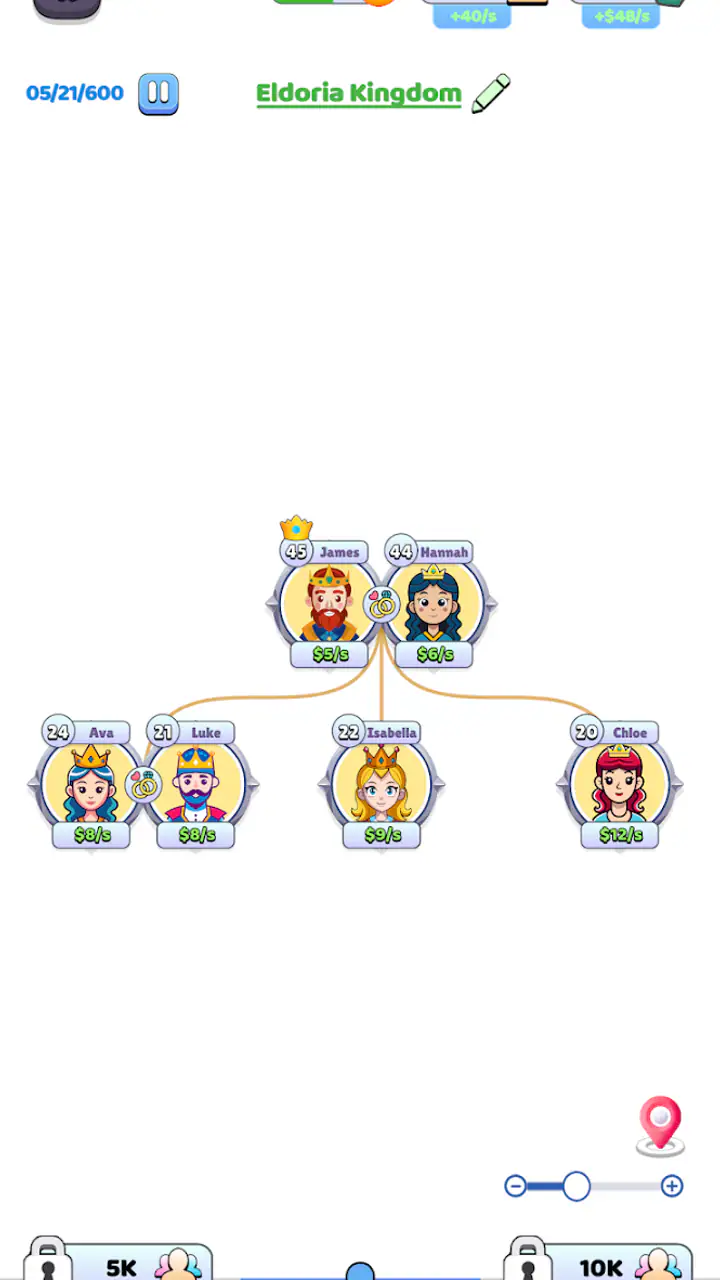
Kingdom Life is the kind of role-playing game that makes a strong first impression by giving every short play session a sense of purpose. I found myself checking the kingdom, making a few decisions, expanding what I could, and then returning later to see how those choices had changed the situation. Its central idea is easy to understand: build a realm, claim more land, and deal with the personal and political complications that come with ruling it.
That combination gives the game a pleasant middle ground between a character-focused role-playing experience and a light kingdom-management game. It is not simply about watching numbers rise, because intrigue and judgment are part of the appeal. At the same time, it does not demand the same concentration as a large, traditional role-playing game. I think that balance explains why it has attracted more than 500 thousand installs and an average rating of 4.1 from roughly 12 thousand ratings.
After spending time with it, my opinion is positive but measured. The opening is inviting, the theme is clear, and the free entry point makes it easy to try. The harder question is whether it deserves a permanent place on your phone once the novelty of founding and expanding a kingdom wears off. For me, the answer depends less on whether you enjoy the first few sessions and more on whether you like maintaining a long-running project through small, repeated decisions.
What makes the opening so easy to settle into
The first-week appeal comes from the steady feeling that the kingdom is moving forward. Early progress is satisfying because each decision seems connected to a visible goal. Expanding territory feels meaningful rather than decorative, while the intrigue gives ordinary management choices a little more tension. I liked that the game frames growth as something that can create complications, not just rewards.
The role-playing label matters here. You are not only improving a settlement in an abstract way; you are also dealing with the consequences of ruling. That makes the experience more personal than a straightforward construction game. When I played in short bursts, I usually had a clear reason to return: continue developing the realm, resolve the next complication, or see what kind of situation followed a previous choice.
Related News

Threads in Real Life: Who Should Join, Lurk, or Leave

How SHEIN Turned Shopping Into an Endless Content Feed

How to Make Fortnite Feel Smarter on Mobile

Should You Switch to Microsoft Outlook on Mobile?

Why Gallery Keeps Pulling Users Back

X Review: Why Its Network Still Matters
That structure works particularly well for people who enjoy games that can be checked frequently without requiring a long uninterrupted session. A realistic everyday use case would be playing during a commute, during a lunch break, or in the evening when you want something more interactive than scrolling but less demanding than a full console-style adventure. A few decisions can feel worthwhile even when you do not have time to settle in for an hour.
The presentation also benefits from a focused premise. “Kingdom Life” is a simple concept, but it gives the game a recognizable identity. You are not left wondering what the main objective is. Grow the realm, broaden its reach, and keep political problems from undermining the work you have already done. That clarity is valuable during the first sessions because it lets you learn through play instead of forcing you to study a complicated system before enjoying yourself.
Still, the early momentum should not be mistaken for unlimited depth. The opening naturally feels more rewarding because every improvement is new. The first expansion, the first difficult choice, and the first signs of political pressure all carry more weight than later repetitions. I recommend treating the opening as a period for learning your preferred rhythm rather than rushing to maximize every possible gain.
Gallery
Small decisions are more important than fast expansion
One of the more useful lessons I took from the game is that expansion should not automatically be treated as the best answer. The temptation is to chase the next piece of land because visible growth feels like progress. However, the intrigue side of the experience means that a larger kingdom also creates more to manage. I found it better to pause occasionally and consider whether the realm was stable enough for another push outward.
This is a practical tip for new players: do not measure a successful session only by how much territory you add. Pay attention to whether your choices leave you with a manageable situation afterward. A smaller, more controlled step can be more satisfying than aggressive growth followed by a scramble to handle the consequences. That trade-off gives the game more personality than a simple “upgrade whenever possible” loop.
I also suggest avoiding the habit of tapping through decisions just to reach the next reward. The intrigue is one of the elements that separates this experience from a basic idle kingdom game. If you treat every event as an interruption, the game can quickly feel like a sequence of chores. If you read each situation as part of your role as ruler, even modest choices become easier to remember and evaluate.
For someone new to this style of game, the best first-week approach is to establish a repeatable routine. Check what needs attention, make one or two deliberate decisions, expand only when it supports the current state of the kingdom, and then stop before the session turns into aimless maintenance. This keeps the early experience focused and makes it easier to decide whether the longer-term loop suits you.
Where it sits beside familiar role-playing alternatives
Compared with a story-heavy role-playing game, Kingdom Life is lighter and more compact. You should not approach it expecting a long, cinematic journey built around constant exploration or elaborate combat. Its appeal is closer to the satisfaction of guiding a growing realm while handling problems that arise around it. That makes it a better fit for players who enjoy decisions and gradual development than for people seeking a large adventure with a dramatic party of characters.
Compared with a pure kingdom builder, it has a more personal angle because the ruling decisions and intrigue are central to the experience. A conventional builder may be more suitable if you mainly want efficient layouts, production chains, or visual customization. Here, the question is not only “What can I build next?” but also “What kind of ruler am I becoming, and what problems will this choice create?”
That distinction helps determine whether the game is worth installing. If your favorite mobile games are fast action titles, competitive matches, or role-playing adventures with constant combat, the slower kingdom rhythm may feel underpowered. If you like checking a developing world and making choices with delayed consequences, the design is more likely to click.
Can the kingdom stay interesting after the first month?
The month-to-month value depends on whether you enjoy recurring responsibility. The game’s strongest long-term quality is not a single spectacular feature; it is the relationship between growth and upkeep. Every expansion gives you another reason to care about the kingdom, but it also creates more opportunities for complications. That creates a loop with some natural tension, provided you enjoy returning to the same world rather than constantly starting something new.
I think the game works best as a background hobby rather than a title that demands your full attention every day. It is easy to fit into a routine because the premise supports brief visits. You can open it when you want a few meaningful choices, then leave it alone and come back later. That makes it less exhausting than a game built around constant competition, although the repeated nature of the tasks can still become familiar.
The important question is whether the decisions remain interesting after you understand the basic rhythm. During the first sessions, almost every result teaches you something. Later, the value comes from managing the kingdom more deliberately and seeing whether your approach produces a smoother experience. Players who like optimizing routines may continue finding satisfaction here. Players who need frequent surprises or a constantly changing campaign may feel the formula settling too quickly.
My advice is to judge the game by the quality of your return sessions, not by the excitement of the first installation. After the initial curiosity fades, ask yourself whether you still look forward to checking the realm or whether you are opening it only because a familiar task is waiting. That is the real test of lasting value for a management-focused role-playing game.
The free price makes that test straightforward. You can explore the core experience without paying at the outset, while optional purchases range from 99 cents to 99 dollars and 99 cents per item. I would approach those purchases carefully. A free game with a long-term progression loop can make spending feel tempting when you are trying to speed up a slow moment, but the better question is whether the purchase improves your enjoyment or merely removes patience from the experience.
For me, the most sensible approach is to play normally for a while before considering any purchase. Learn how quickly you enjoy the routine, decide whether you like the way expansion and intrigue interact, and only then think about spending. This is especially important for anyone who prefers games with predictable costs. The free entry point is attractive, but the optional price range means the game is best enjoyed with a personal spending limit already in mind.
How to make recurring sessions feel less repetitive
A useful long-term habit is to give each session a small purpose. One visit might focus on preparing for expansion, another on resolving a political issue, and another on reviewing whether the kingdom has become harder to manage. This prevents the experience from becoming a mindless sequence of taps. It also makes your progress easier to evaluate because you know what you were trying to accomplish.
Another tip is to keep track mentally of the choices that caused trouble later. The game becomes more engaging when you treat consequences as feedback rather than bad luck. If an ambitious decision creates pressure, that is information about your ruling style. You can then decide whether to compensate with a more cautious approach or accept the cost because the larger gain is worth it to you.
I also found that stopping at a natural point is healthier than forcing one more round of progress. When the game begins to feel like maintenance without a decision behind it, closing it and returning later can preserve its appeal. This is a small but important distinction: a game designed around repeated visits should support a sustainable habit, not encourage you to turn every visit into a lengthy obligation.
That approach will not transform the game into a deeper role-playing epic, but it does help its existing strengths last longer. Kingdom Life is at its best when you are making choices with intention. It is weaker when you treat it as a checklist that must be emptied every time you open it.
The maintenance burden and the points where fatigue appears
Every growing kingdom eventually creates work, and that is where the game’s central appeal can become its main source of friction. Expansion feels rewarding at first because it demonstrates success. Over time, however, the same growth can make each return feel more like administration. If you prefer a clear ending or a tightly paced campaign, the ongoing nature of the experience may start to feel less satisfying.
The maintenance burden is not necessarily a flaw. In fact, it is part of the fantasy of ruling a kingdom. The problem appears when the balance shifts from meaningful decisions to repeated obligations. I noticed that the game is most enjoyable when I had to choose between reasonable options. It became less compelling when I was simply checking in to preserve momentum.
Intrigue can also produce mixed feelings. It adds character and prevents expansion from being completely mechanical, but political complications may interrupt the simple pleasure of building outward. Some players will enjoy that friction because it gives the realm a story. Others may regard it as an obstacle placed between them and the upgrades they actually want. Your reaction will depend on whether you see setbacks as part of the role-playing or as unnecessary delay.
Another possible source of fatigue is the gap between short sessions and long-term ambition. The game is comfortable in small doses, yet a kingdom is a project that invites you to think ahead. If you return often, you may feel pressure to keep the project moving. If you return only occasionally, you may lose the thread of your previous decisions. I recommend using a relaxed schedule rather than trying to maintain perfect continuity.
The age rating is Teen, which is worth keeping in mind for families deciding whether this is suitable for a younger player. The rating also fits the tone implied by intrigue and ruling: this is not presented as a purely childish building toy. Parents should still consider whether the game’s themes and optional purchases fit the player’s age and household rules.
The technical entry point is relatively broad, with a minimum operating system of Android 7.1. The current version is 1.1.7, so keeping the app updated is sensible when possible. I would not choose it solely because of that compatibility, but it does make the game accessible to people who are not using the newest phone. As always with a progression-based game, I would also avoid treating it as something to install and uninstall casually if you care about preserving your progress.
Who should skip it
I would skip Kingdom Life if your priority is fast action, deep tactical combat, or a role-playing game with a strongly directed plot. The kingdom theme may sound broad, but the actual appeal comes from gradual development and repeated management. Anyone looking for a self-contained adventure with a clear finale may find the continuing loop unsatisfying.
I would also be cautious if you dislike in-app purchases in free games, even when you can begin without paying. The listed item range is wide enough that spending discipline matters. If seeing optional purchases makes it difficult for you to enjoy a slower pace, a paid game with a fixed upfront cost may be a better choice.
Finally, it may not suit players who want every session to feel dramatically different. The game’s value comes from building a relationship with one evolving kingdom. That is a strength for patient players, but a weakness for anyone who quickly loses interest once the main loop becomes familiar.
My long-term verdict on keeping it installed
Kingdom Life earns its place as a relaxed, decision-driven role-playing game with a clear identity. Supersonic Studios LTD has built the experience around a premise that is easy to understand but flexible enough to support personal choices: grow the realm, expand carefully, and deal with the intrigue that follows power. I enjoyed the way expansion is never entirely separate from responsibility.
Its strongest quality is the fit between short sessions and gradual progress. I can imagine recommending it to a friend who likes checking a developing world in spare moments, especially someone who prefers management decisions to reflex-based play. The game also gives newcomers useful room to experiment before they decide whether its long-term rhythm is right for them.
Its weakness is equally clear. Once the first excitement of building a kingdom fades, the experience relies on your willingness to maintain the same project. The recurring decisions can remain satisfying, but they can also become routine. Intrigue adds welcome texture, yet it may feel like friction when you are tired or simply want uncomplicated progress.
My final recommendation is to try it as a low-pressure habit, not as a game you must play constantly. Keep your expansion measured, read the political choices instead of rushing through them, and set a spending boundary before optional purchases become part of the routine. If you enjoy watching a realm develop through many small judgments, it can stay rewarding beyond the first week. If you need constant novelty or a definitive story campaign, your phone space would be better used by a more focused role-playing alternative.
With over 500 thousand installs, a free starting point, and a Teen rating, it is easy to see why the game attracts a broad audience. My own conclusion is that it does not win through spectacle; it wins when its steady rhythm matches your habits. Its lasting value comes from deliberate kingdom maintenance, not from endlessly chasing the next expansion.
FAQs for Kingdom Life
What is Kingdom Life, and what can I do in the app?
Kingdom Life is a mobile game focused on building, managing, and developing your own kingdom. Players typically expand their territory, collect resources, upgrade buildings, complete missions, and improve their characters or army. The experience combines strategy and progression, so it may appeal to users who enjoy planning upgrades and gradually unlocking new content rather than playing short, completely independent levels.
Is Kingdom Life free to download and play?
Kingdom Life can generally be downloaded without an upfront purchase, but users should expect optional in-app purchases. These may include resource packs, premium currency, special offers, faster upgrades, or additional gameplay benefits. The game can usually be started for free, although progress may take longer without spending money. Parents should also review purchase settings if children use the device.
Does Kingdom Life require an internet connection?
An internet connection may be necessary for important parts of Kingdom Life, especially account synchronization, online events, advertisements, updates, rewards, and any multiplayer or competitive features. Some basic activities might work temporarily offline, but this should not be assumed for the complete game. A stable connection is recommended to prevent lost progress, loading problems, or interruptions while playing.
Is Kingdom Life suitable for children?
Kingdom Life may be suitable for older children and teenagers, depending on the game’s official age rating and the way each player responds to strategy, competition, and in-app purchases. Before downloading, parents should check the store classification, privacy information, advertising content, and chat or social features. It is also advisable to enable parental controls and require approval for every purchase.
What devices are compatible with Kingdom Life, and how much storage does it need?
Compatibility depends on the specific Android or iOS version available in your region, as well as the minimum operating-system requirements listed on the official store page. Kingdom Life may also require additional free storage for downloaded assets, updates, and temporary files. Before installing, check the app listing for supported devices and make sure your phone has enough space and an updated operating system.
Pros
- Simple controls make the game easy for new players to pick up.
- Short play sessions suit casual gaming on mobile devices.
- Kingdom-building goals provide a clear sense of progression.
- Colorful visuals give the game a cheerful and approachable style.
- Regular tasks can encourage players to return each day.
Cons
- Progress may feel slow without frequent play or extra resources.
- Repeated missions can become predictable after extended sessions.
- Small interface elements may be difficult to use on compact screens.
- The game may require a stable internet connection for some features.
- Device performance can affect loading times on older phones.


